Short version: Human consumption of energy and demand for products is driving climate change. Everything makes a difference, from the green house emissions due to our energy uses to our personal choices leading to deforestation on the other side of the world. We are reaching a tipping point where another small increase of temperature could lead to a snowball effect that puts climate change beyond our control. If all our choices are causing climate change then we can make changes to stop it. We can make choices now, in our everyday lives to slow down climate change.
For some reason my other half saw fit to put on Climate Change – the facts by Sir David Attenborough on TV on Christmas Eve. Er… yeah… little bit hypocritical of us given the gluttony and consumerism in the holidays.
If you haven’t seen it (it is very much worth watching), these are a few points:
Greenhouse gases, mostly carbon dioxide and methane are causing the temperature of the earth to rise with dire consequences:
Death of species unable to adapt quickly enough.
Melting of glacial ice is leading to rising sea levels and unpredictable stormy weather is leading to flooding. Homes are destroyed and people are being relocated. The melting ice also releases trapped pockets of methane (a worse greenhouse gas than carbon dioxide) that exacerbates the problem.
Wildfires are raging out of control killing wildlife and destroying habitats and homes. The burning of the wood releases more carbon dioxide.
Deforestation is still continuing at a massive rate which is a problem for many species but inevitably for all, as the world’s forests, by photosynthesis, can suck up and store much of our carbon dioxide. With their ever diminishing size they are less and less able to mitigate human behaviour. Now a third of our CO2 emission is caused by deforestation. Rainforest is cleared and burned for soybeans, rubber, pasture for cattle and mostly palm oil. Demand in other countries is driving deforestation.
There have been some big changes like the switching from fossil fuels to renewable resources. Countries, depending on their situation are increasingly turning over the majority of their energy production to wind farms, solar cells or hydro electricity. There are other sources but these are the most prevalent.
Now this is the bit that is relevant to you (and me)… well all of it is relevant but it feels overwhelmingly difficult to comprehend and/or face the problem that we, as humans, have created for ourselves. Every person has a yearly carbon footprint. Everything we buy has some sort of carbon footprint. We can reduce this by simple things like insulating the house (which also reduces bills), buying less products (or by buying products of better quality that last longer). Because a quarter of the carbon footprint in the UK is food, that can be cut in half by:
eating everything you buy i.e. avoiding waste
avoiding air freighted food
reducing dairy and meat – especially beef and lamb
The take home message was that we can all change our own behaviour and convince others too. Right now, we can still halt climate change – but there is only a small window before we reach a tipping point.
So… all a bit bleak – but let’s try and make this easier to see. Firstly, CO2 is a colourless gas! A tonne of carbon dioxide is a bit abstract. You can think of it as a cube with sides of 27 feet – around 8.23m – so 557.44m3. (click here for the source)
Then what does that look like in terms of use? Well, driving 10,000km in a petrol car creates around 2.5 tonnes (a diesel car is higher).
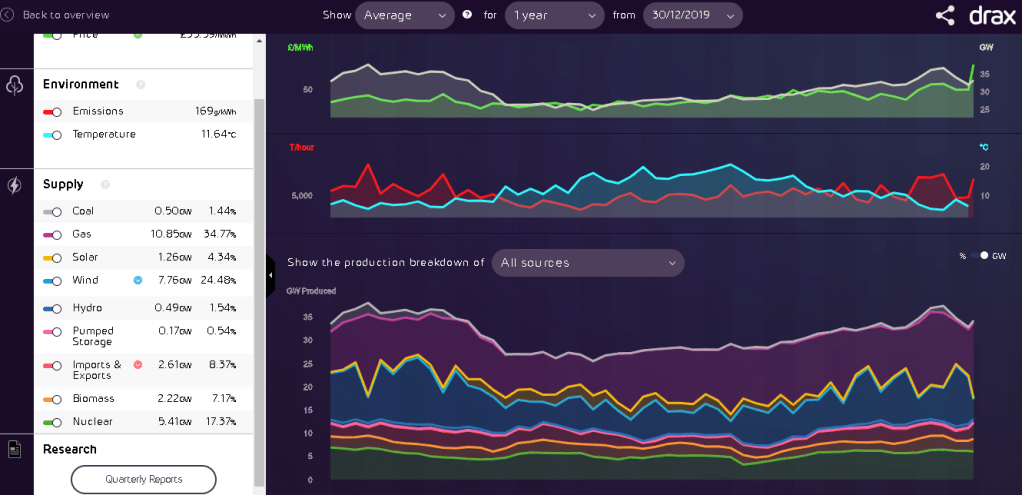
As I understand it, these figures include energy consumption, transport, products and services. There will be some things that are improving as countries turn their energy sources over to more renewable sources. Here we can look at the Drax website and you can see what percentage of the UK’s energy is derived from which source. If you compare 10 years ago to last year, in rough figures – coal went down from 30% to 2%, gas also came down from 47% to 35%, wind went up from 3% to almost 25%, nuclear didn’t move much from around 17% and hydro, solar and biomass combined have gone from almost zero to 13%.
2010
2020
So much of what we buy have carbon footprints we don’t see. Take, for example, the box of chocolates that I’m feeling rather guilty about nibbling on:
Packaging – cardboard, foil, plastic – a tree was felled, metal ore was mined and extracted, crude oil was drilled and extracted as a raw material to make plastic… all of these things need a certain amount of transport and manufacturing and of course there’s also the dyes involved in the colours of the branding.
Ingredients worth noting:
Sugar – can be grown in the UK, but requires much processing.
Coconut oil – which isn’t grown here
Palm kernel oil – really REALLY bad as it is one of the main crops that drives deforestation.
Cocoa – which is definitely not grown here must be processed and shipped.
Milk products – the dairy industry is a pretty hard on the environment. Rearing cows is energy consuming and cows produce a lot of methane.
All the ingredients must be transported to the factory and the chocolates produced and package. Then there is transport of the chocolates to the shop (then my kitchen table). Wherever energy is used in manufacture or transport chances are it will have caused the release of greenhouse gases. Demand for the ingredients like palm oil supports deforestation. I’ve never really noticed any of that carbon footprint till today. You may be pleased to know that I no longer feel like eating them.
So, my message, in the first blog of 2021 is that it’s not too late to do something about climate change, but time is short. It does require governments and industry to make the big changes, but in turn, these changes can be driven by voters and consumer behaviour. You can do little things to make a difference. Any changes that we make, no matter how small, can make a difference – especially if everyone gets involved. You could start small to keep it achievable or just by considering more environmentally friendly options through the year you could make a difference. I’m sure you all have plenty of ideas. All are welcome in comments. I’ll be implementing some of the things I’ve mentioned in this post into New Year’s resolutions, especially considering the products I’ll be buying, but as always, I’m very edible garden orientated and I believe it’s not just about what you do yourself – but also about getting the message out there and encouraging others:
Grow food. I encourage anyone, everyone to grow some food, even if it’s just on a windowsill or a balcony. The growing plant will take in carbon dioxide. Any food you can get from what you grow will have a tiny carbon footprint in comparison to something grown using intensive farming methods or something that required transportation. I think you can also be pretty sure that the things you grow to eat didn’t encourage deforestation on some other patch of earth. Eating plants over meat is much more environmentally friendly. This is one of the things we, as a family need to look at most. We do eat far too much meat, but, if we can grow more tasty veg (and home grow is definitely tastier), especially in the winter months and maybe in the lawn (I’m thinking of replacing our diminishing patch of grass with a bed or maybe just sowing some things in the grass itself), then maybe we’ll find it easier to eat less meat.
Composting of kitchen greens and waste cardboard reduces transport of waste and reduces the need for fertilisers or shop bought compost, both of which have manufacturing, as well as transport, carbon footprints. Click on each of the following for more info: composting, fertilisers, reusing and recycling at home, reusing and recycling in the garden.
Grow more perennials and self seeders. I’m going to grow more of these this year as perennials store carbon and buying seeds annually does require them to be produced and shipped. Seed sharing with others would be another option.
Short version: Compost certain types of kitchen and garden waste to get free fertiliser in a way that’s great for the environment. The cheapest and easiest way to compost is to take green kitchen scraps and bury them in a hole in the garden. Seriously. That’s it.
I’ve split this into 3 parts on the website pages as it’s a loooong read but kept it intact for the blog so it’s in order. If you don’t want to scroll through the whole thing here are the separate links:
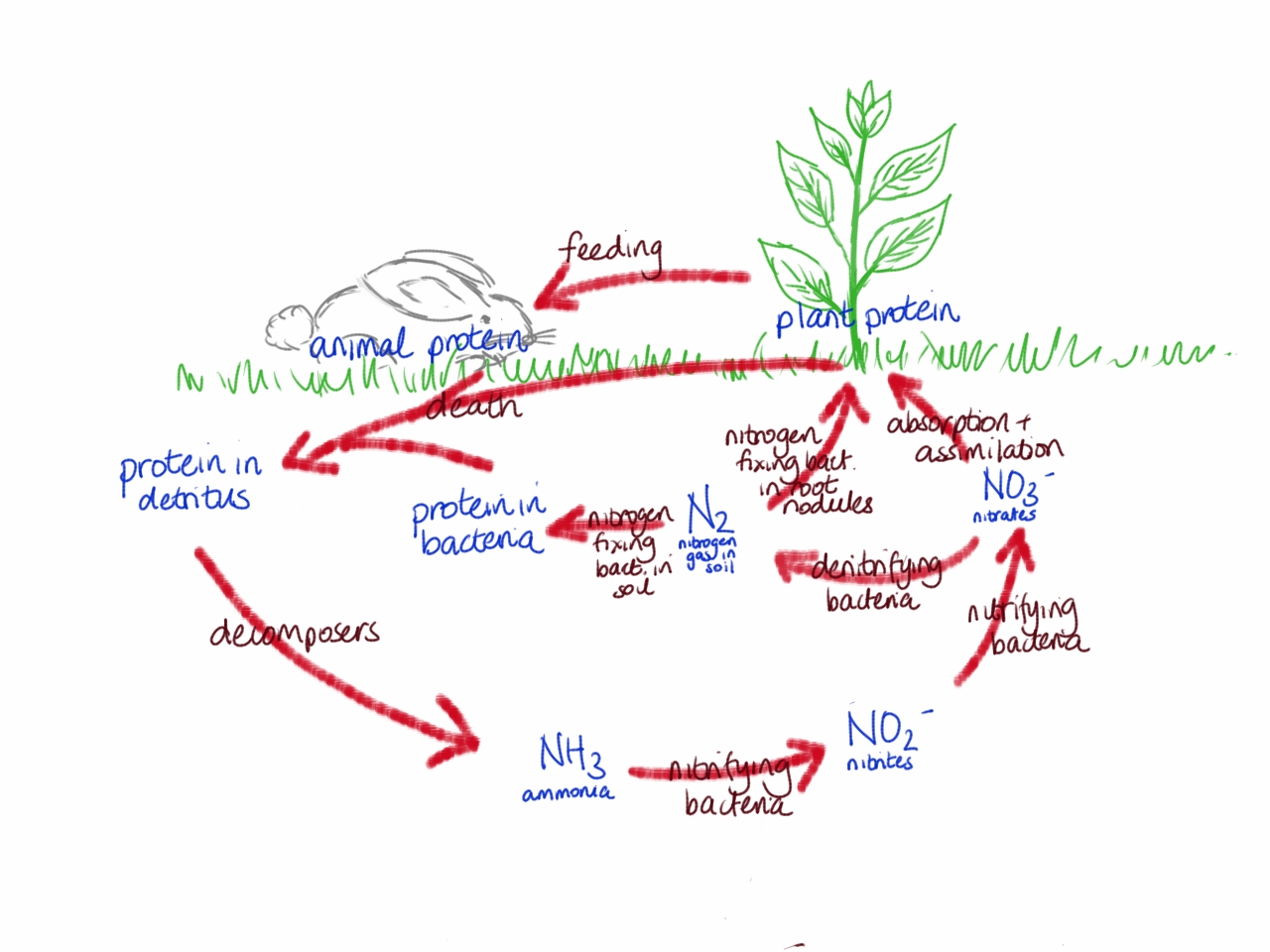
You can look at the nitrogen cycle and see how this single nutrient moves from the soil, to plants, to animals (sometimes) and back to the soil again in an endless cycle.
It’s not all about nitrogen though. Plants need 13 minerals in order to thrive. Of these nitrogen, phosphorus and potassium are needed in large quantities and sulphur, magnesium and calcium are needed in lesser quantities. The other 7 are needed in very small amounts. Basically, once a plant depletes the nutrients out of the soil those nutrients need to be replaced. In nature the plant will in due course die (or parts will die, like the leaves in autumn), or get eaten and poo-ed out (yes – we’re all thinking Lion King… ) and then these nutrients are replaced back in the soil. For a healthy garden it’s important to put these nutrients back in as we grow and take things out. Otherwise they’re not there for the next thing you grow. Of course, you can buy a packet of fertiliser in the shops but then you may want to consider what goes into fertilisers. I don’t have a fear of chemicals. It’s the energy and cost to the earth that I’m worried about. You can see the arguments in ‘Fertilisers’ and ‘Eutrophication.’
Also, why pay for something, when you can use stuff you were going to throw away anyway. Compost, made from a variety of kitchen and garden waste, will contain these minerals. The amounts will depend on how much of these minerals the dead matter had to begin with. Also, with compost you get a good growth medium. It holds water well but drains well too. That is something fertilisers won’t give you.
Lambeth council collects food waste
You get a small tub to keep in the kitchen and they supply compostable bags. In a week we have 1/2 to 1 whole tub.
Weekly we compost the equivalent of 1 to 2 grey tubs full.
Another thing to consider is – what happens to this waste
otherwise? If you have a council that collects everything in one go, then you
can expect the waste to go to landfill. If you have a council that collects
garden waste or food waste that’s better – but if you process it yourself then
that’s less energy being spent on transporting (yes they’re making the journey
round the houses anyway – but extra weight requires extra fuel) and then
processing it. Even your cardboard boxes are great for composting.
What to compost?
From the house:
Vegetable and fruit peelings and bits (apple cores, banana peels, that orange that went mouldy at the bottom of the fruit bowl)
coffee grounds and tea leaves (we compost tea bags – but be aware that the bag itself will often contain plastics see previous post ‘Composting tea bags’)
NO dairy, oils or meat.
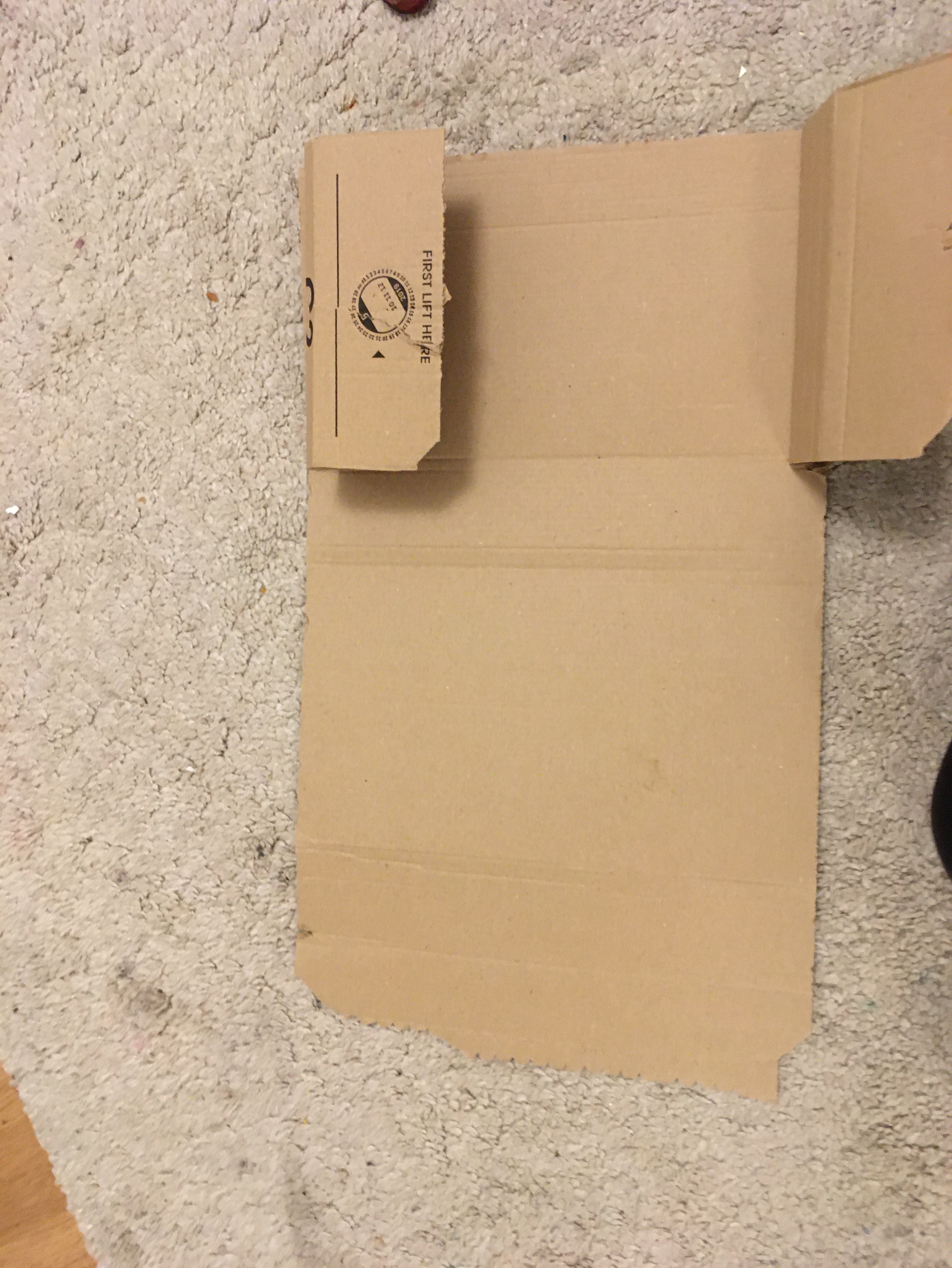
Shredded cardboard and paper without inks or dyes. A bit of common sense may be needed e.g. A paper towel used to mop up spilled juice or something is fine but not if you’ve cleaned up sauce or oil. Remove plastic and labels from cardboard.
Amazon package – prepped whilst watching Octonauts with my monkey. She ‘helped’ (ripped up a bit and then threw it around).
Remove any labels, then shred as small as you can be bothered. It’s a nice little task you can do on the phone or in front of the TV.
From the garden:
Any plant matter that is not diseased or heavily infested with pests.
NO roots and seeds of perennial weeds. Be aware that any seeds may not compost and could sprout when you use your compost.
Any wood bits should be chopped up or you are literally looking at years for that bad boy to decompose.
I rarely chop stuff up, but should. Composting is much quicker for 3 mins chopping.
Chopping things up helps to speed up the process but if
you’re quite lazy like me you don’t need to. You just have to leave it to
compost for longer.
For those who want a bit of jargon:
Green waste is leafy stuff, green stems, grass cuttings, the kitchen peelings and cut offs, coffee and tea. It is rich in nitrogen.
Brown waste is things like cardboard, paper and woody garden waste. It tends to take longer to break down and it is rich in carbon.
Hole Composting
What to compost?
For hole composting you’re best sticking to green waste from the kitchen: Vegetable and fruit peelings, cut offs and cores, tea leaves (bags are fine – but be aware that the bag itself will often contain plastics – see ‘Composting teabags’) and coffee grounds. You can add a small amount of brown waste like shredded cardboard.
How to hole compost?
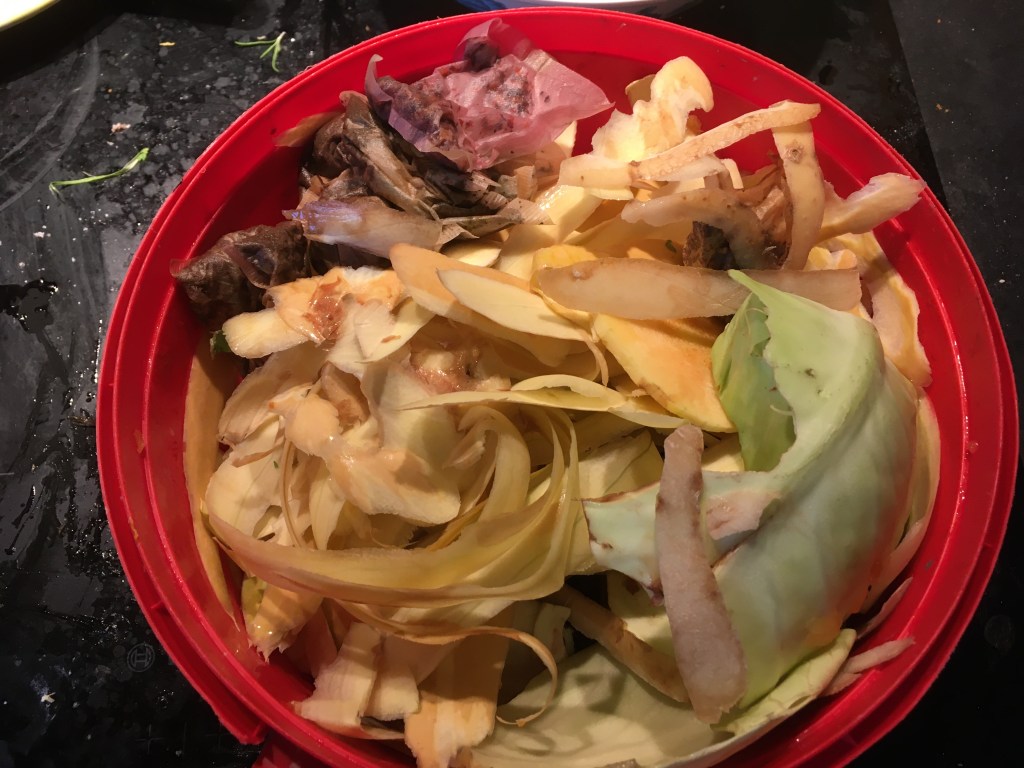
I have an old plastic sweet tub that I keep next to the sink that I just sling stuff in. Something with a lid keeps smells in and flies out (mostly fruit flies as house flies are attracted to meat). Every few weeks I’ll give it a good wash (in the dishwasher usually – cause I’m lazy) just to keep the smells and mould at bay. I don’t use composting bags (bags that go into compost that break down) as they require energy to process the materials, to make and to deliver… and they’re not free. Also the smell in my tub isn’t bad as it’s all vegetable and fruit matter and stays on the counter top a maximum of a week. I do use composting bags for the council collected food waste. That smell just makes me want to go shower. If composting bags help you to compost, then better to compost and use a bag than not composting at all.
It may not be that pretty, but reusing plastic containers is better for your pocket and the environment.
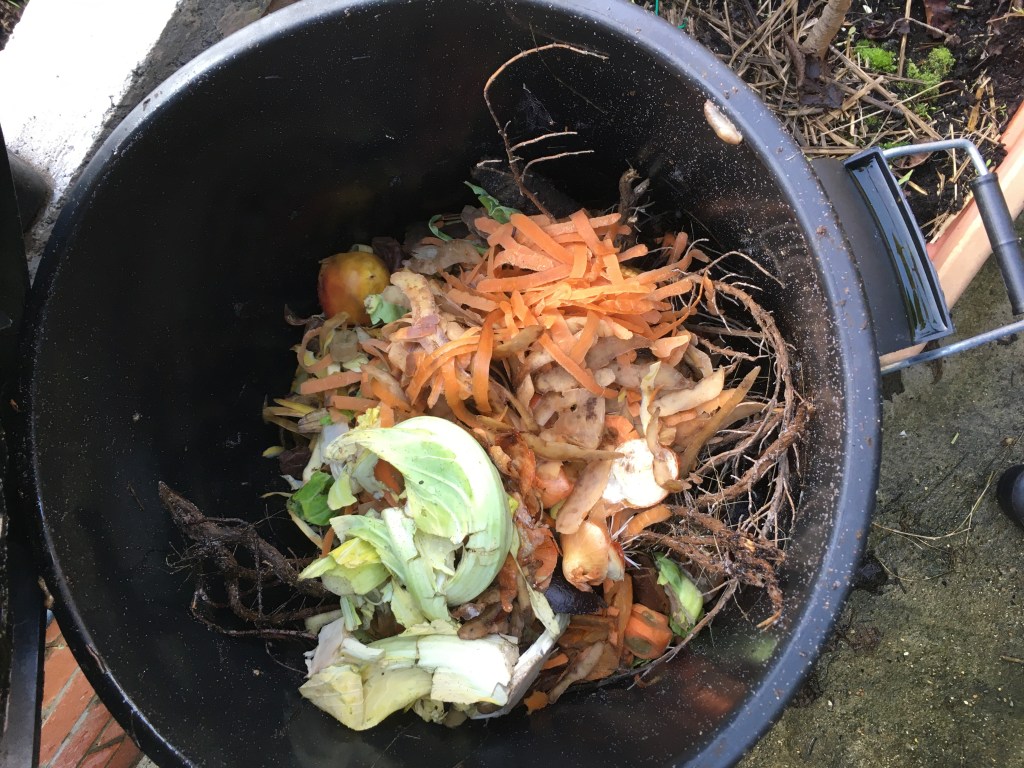
Tea, cabbage, apple, banana, squash peel, melon rinds, fine bean ends, onion bits, citrus peel, potato and carrot peel from one week.
When it’s full I’ll either bury it in the garden or put it in the compost bin. Despite saying that hole composting is the best, I mention a compost bin because I’m afraid it isn’t always appropriate to use hole composting.
Dig a hole. I just use a trowel. For a large sweet tub, I dig a hole that’s about 40cm wide and about 20cm deep. The deeper you bury, the less likely something will be attracted to it and dig it up. We have cats and foxes around us, and they don’t care for the type of stuff I bury.
Chuck the contents of the tub in. Give it a mix with the
soil underneath it (and maybe an extra chop with the trowel) to introduce lots
of microorganisms to it.
Cover it with the remaining soil.
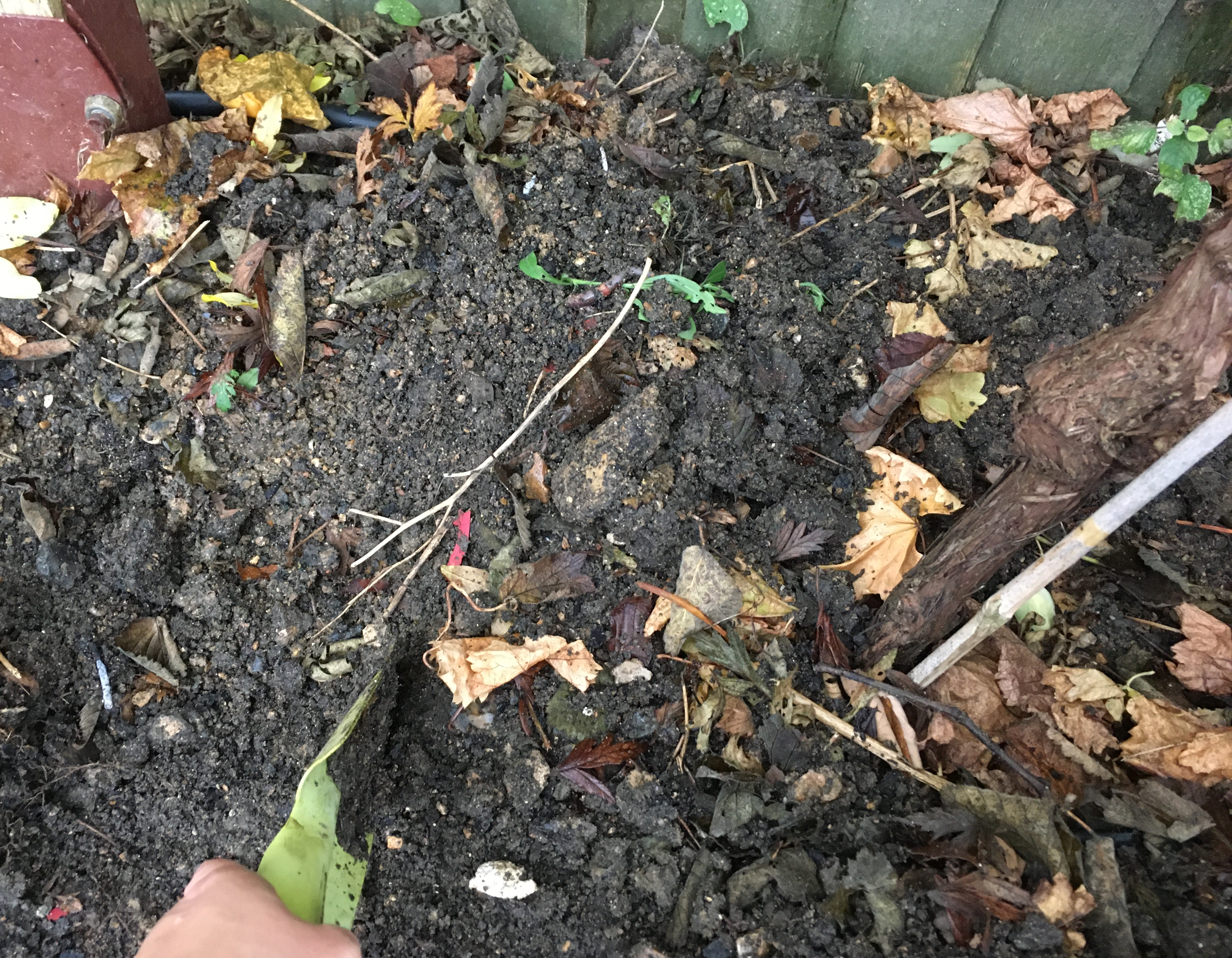
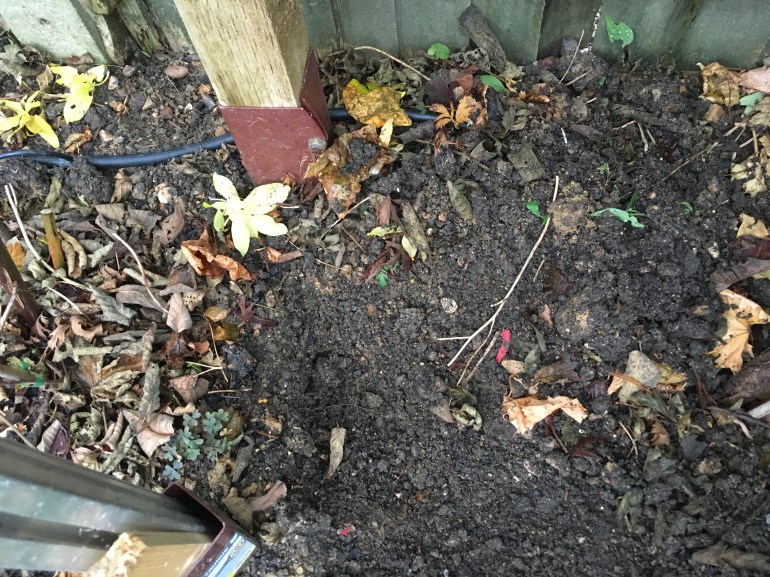
The perfect spot
Not too close to the grapevine on the right.
Doesn’t look like it, but I swear I dug a hole
A week’s worth in…
…mixed with the soil to introduce microorganisms…
… cover back up.
Where to hole compost?
My memory isn’t as good as it used to be so when I hole compost,
I start at one end of the garden, bury my kitchen waste and then mark the next
spot to dig with a trowel.
I move hole by hole round the garden and when I get to the end in about 2 months or so, I’ll go back to where I first started. Things will have had time to turn into lovely compost, especially as the worms and microorganisms in the soil will have helped out. The worms will burrow through the soil and compost and aerate it The microorganisms need air to do their thing and, albeit slowly, the worms tunnelling through will help spread out the compost with its nutrients through the soil around it.
If you have any perennial plants, then you want to bury away from the roots. By digging you can damage the roots. You also don’t want to put a large amount of uncomposted material too close to a young plant. During the breakdown process the plant that is growing and the microorganisms doing the breaking down compete for resources. Therefore, it can be worse for the plant in the short term.
10 days later much of it is unrecognisable and there are plenty of worms.
Some things like the banana skins, teabags and apple aren’t visible, but the squash peels (which of course protect the fruit) are still intact.
When to hole compost?
This is something that I prefer to do in the winter months. This is when I have the most access to the soil as many of the plants have died back.
If you grow annuals, then you should wait till all the
plants have been harvested and then fill your growing space with lots of buried
pockets of potential goodness. Start doing it as soon as you have harvested and
carry on till around early February. Then the material has time to break down
before planting begins in spring.
This is why as well as hole composting, I do have a compost bin (see ‘Bin composting‘ for details). I can’t always access the soil to dig a hole, so during this time it goes into a compost bin.
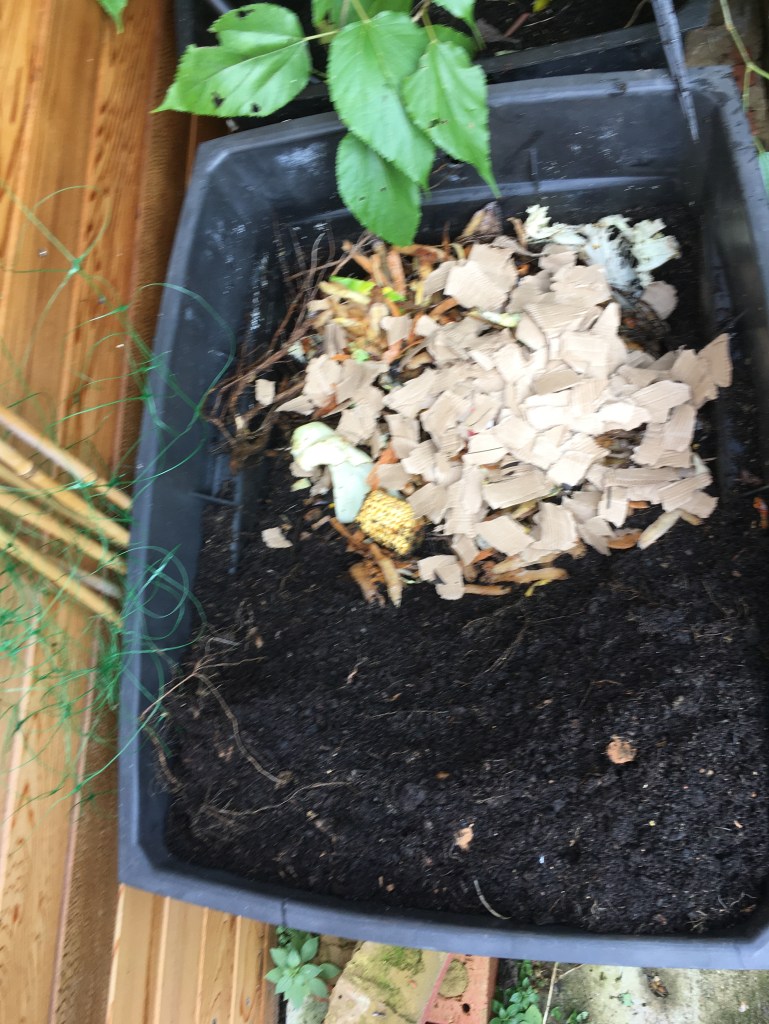
This can also be done in really large pots. This old water tank recently had tomatoes and French beans. Dig as deep as possible.
To avoid removing the soil I do one side at a time, pilling the soil on the other side. Here I’ve also added shredded cardboard
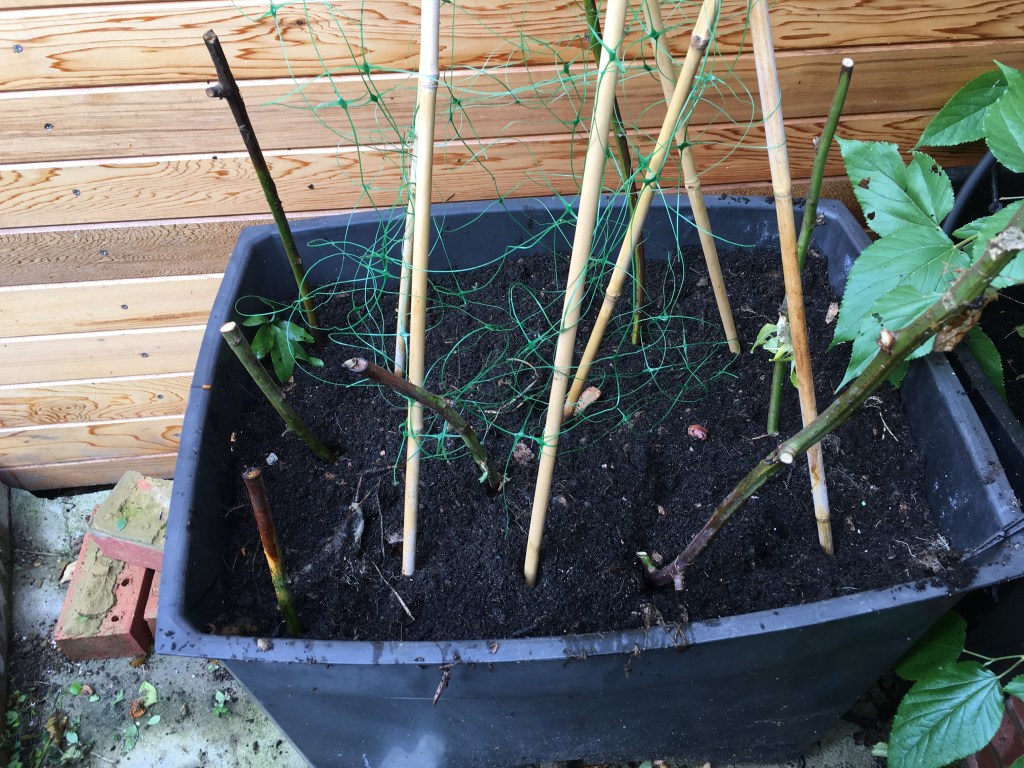
After mixing it all up and doing the same to the other side it has all been covered over and bamboo canes and twigs have been added to deter cats from using it as a litter tray. I know from last year that there are some worms in here, but every time I come across worms I add them into this pot.
A variation on hole composting
Every now and then I reclaim a bit of the lawn and make another vegetable bed or find myself a pallet that I recycle into a raised bed (see ‘Pallet planter’). I have 2 ways to fill the beds that don’t involve buying compost:
Cover the bed with a couple of sheets of
cardboard. Then every time I have a sweet tub full of waste or have garden waste,
I lift the edge of the cardboard, chuck the waste in and then let the cardboard
fall back down. The cardboard keeps animals from digging in there. Occasionally
I shred a cardboard box and add that in and sometimes when I have a spare
moment, I’ll give it a mix with a garden fork. Because you’re not digging a
hole once a week it’s even lazier and quicker.
When I haven’t had access to the soil in the
summer months, I collect the kitchen and garden waste in a compost bin and then
just pour all that in, in one go.
After a year, because I didn’t chop these up, there were still bits of twig.
When the bed is as full of compostables as I’d like, I give it all a good mix and cover it with a 5cm layer of old compost. This will usually be the ‘spent’ compost from pots that have had annual fruit and vegetables growing in it and it would be low on nutrients. I then leave it for around 2 months for the worms and other organisms to move up into it out of the soil and for the microorganisms to break it down. The smaller everything is chopped up before it goes in the more it would have decomposed. Bits of wood don’t decompose quickly.
Anyway, hole composting is great when you don’t have the space for a compost bin, or just want an easy way to add nutrients back into the soil.
You can really see the results of the composting. January 2019 I made this pallet planter. The bottom of it had sheets of turf that I had removed from the lawn. This also introduced microorganisms and worms. The middle was all garden and kitchen waste then it was topped with soil from spent pots:
In spring the sugar snap peas did really well and the yacon below started to fill out.
By summer, the peas fell prey to powdery mildew, but there was a giant tromboncino that looped over the fence and back. The yacon began taking over.
Now it’s winter the tromboncino is gone and the yacon is staring to die back, but you can see how tall it got. All that growth from just using what would otherwise be thrown away.
So for times when hole composting doesn’t work – or it is just isn’t for you:
Bin Composting
What to compost?
You need a good balance of green and brown waste. Too much
green and you get a slimy rather wet mush. Too much brown and it can be dry and
slow to compost.
If your compost bin gets slimy and wet, you need to add more brown. If it is too dry you can add water and/or more green.
Filled with garden waste
This is mostly kitchen waste with a dead rosemary bush I should have chopped up. When it is half full I’ll mix in some cardboard and let that decompose (turning it occasionally).
How to bin compost?
Put everything into a compost bin. Turn it regularly with a garden fork to aerate, as the microorganisms that break down the organic matter need oxygen. Be patient. It takes time for your waste to be turned into compost. Chopping things up small will speed up the process but then it takes time and effort. Turning regularly speeds things up but again requires time and effort. You may have also spotted a problem here. If you are going to be constantly adding waste, then no matter how much you aerate it there will always be some bits that have only been hanging around for a few days. Therefore, ideally, you need more than one. You fill one up and then aerate that one and allow it lots of time to decompose as you fill up your second one.
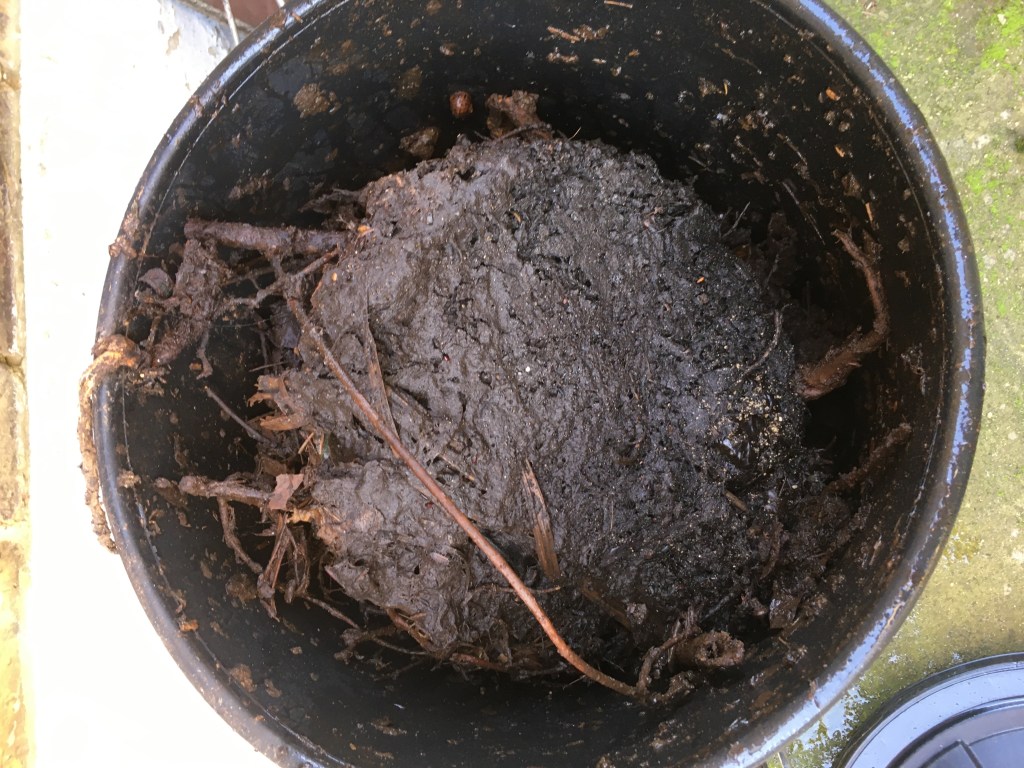
There is often a brown liquid (leachate) that is rich in nutrients that drains off composters. This is can be used neat or diluted as a liquid fertiliser.
This is 1 month old garden waste
This is another month later
Another month after that
How to choose a bin?
A bin that is NOT airtight or waterproof allows little
organisms like worms and millipedes to get in and help to break the matter
down. They must then have an escape route. A bin with the correct balance of
greens, browns and water should heat up, which makes break down faster. You
don’t want to trap any helpful creatures in there. There are a variety of
compost bins on the market and some that you can make yourself. These are the
ones that I’ve come across.
I only had one pallet. I made a planter instead.
Pallet composter
This is the bee’s knees of composters. You build a cube with an open top and bottom out of 4 pallets. Alternatively, you use 3 pallets and leave the front open too to make turning easier. My dad made one.
If you have the space and lots of pallets this is a cheap and environmentally friendly option. It allows access for worms and easy aeration. I have never had a garden with enough space. I don’t think anyone in London would. Don’t forget – you ideally need 2 compost bins.
The open bottomed upside cone composter
This was one I hated that came with the house that we were living in about 10 years ago. It was basically a green plastic cylinder which tapered towards the top and had a removable lid. The open base was supposed to allow organisms to enter and so you could remove the whole structure, leaving compost where it used to be, but what happened instead was whenever I tried to remove the tight lid, I’d lift the whole structure and half decomposed matter would pour onto my shoes. The tapered top meant that it was hard to get a garden fork in to aerate it. Due to the open bottom it had to be kept on soil. I hated how much space it took up and how it couldn’t be moved. This is just a picture off the internet. It wasn’t quite this one, but it looked a lot like it.
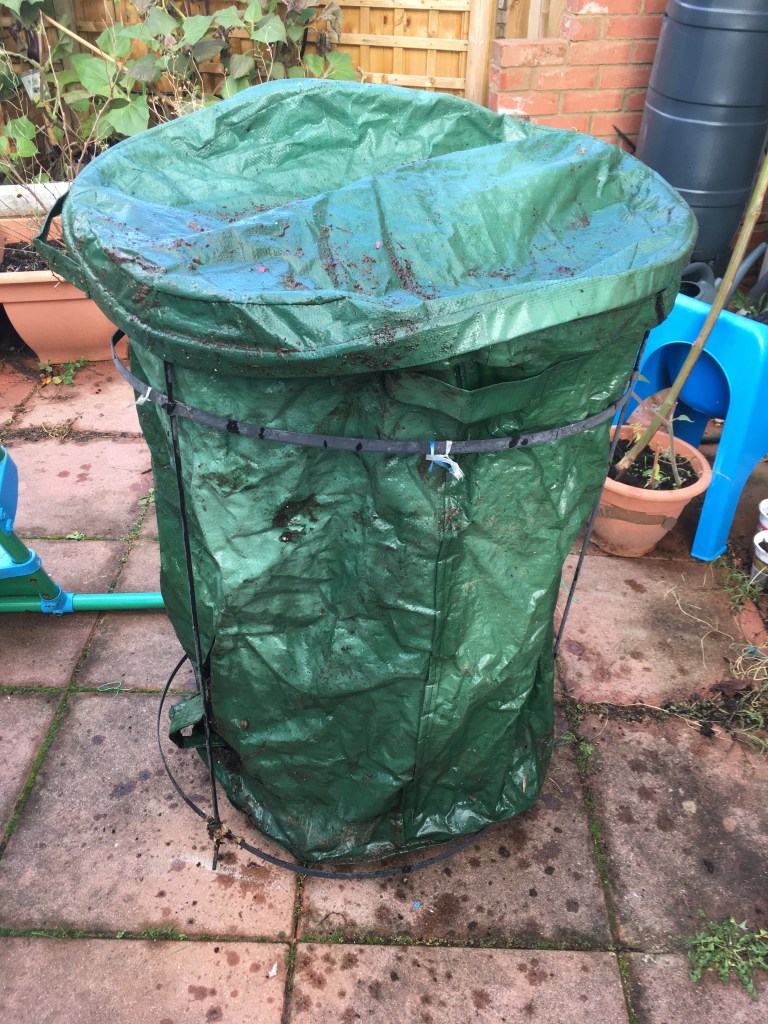
Cheap compost bin with a wire frame and tarpaulin sides
This was about the size of a household wheelie bin. It had a
flap in the side stuck on with Velcro so you could open it for access to
compost at the bottom. We chose something as large as possible for the price as
we had finally gotten a place with a decent garden.
This wasn’t bad and we used it for almost 2 years. It was cheap and with a closed bottom it could go anywhere. Unfortunately we found that things didn’t decompose particularly quickly (no access to organisms and a pain to turn). The sides were a bit flimsy and it was impossible to move when even a quarter full. Also the velcro on the flap became clogged and then it wouldn’t close so it leaked goo constantly.
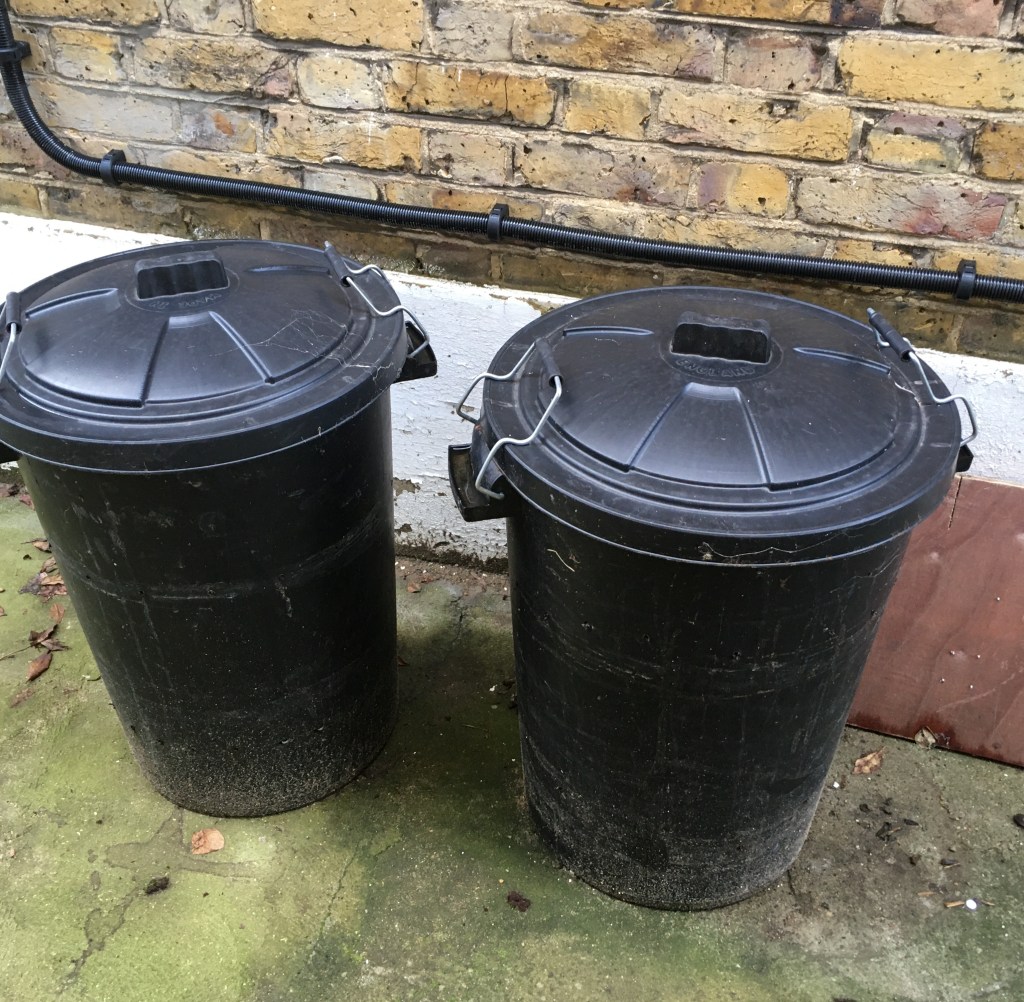
2 rings of little holes to provide air
Rotating compost barrel
This is a barrel mounted on a stand that you can rotate to easily aerate it. They’re expensive. So for half the price of the smallest, cheapest one I made 3 from black bins. There are plenty of good youtube videos on how to make a proper one on a stand, but I didn’t have the patience or the space. Mine are literally black bins with lids that can be tightly sealed that I’ve drilled 2 rings of holes in. I also made a board with wheels so that I could put the bin on top of it and rotate it, but then decided that it was easier just to push it around with a wellied foot. I’ve had these for about 6 months so far and I absolutely love them. They’re easy to make. Turning the compost is very easy. If you roll it on the grass the leachate (brown nutrient filled water that leaks out of the hole) fertilises the grass. Each one is light enough to be taken around the garden to collect waste and small enough to be tucked into a corner when not in use.
I keep these 2 with a board that has 4 wheels screwed in.
I can lay the bin on the wheels to rotate it
I have found that just pushing it around is easier
Sounds perfect. The only problem is – I bought something plastic and new. I am bad.
Anyway…the compost bins hold the waste in the summer when I can’t hole compost. Once I have bare earth I start hole composting again. With perennial plants I haven’t dug close to their roots in hole composting, so in the spring I use the compost that is made in bin composting to mulch around them to provide nutrients.
Please please please do give composting in some form a go – even if you dig just one hole! It’s better in the garden than landfill or being collected for processing. It’s a free, natural way to fertilise your garden. It’s good for the environment and it’s good for your plants.
Inorganic fertilisers have changed the world but maybe now we
need to consider the impact of their use and production. Organic fertilisers
may be slower to work but they don’t consume as much energy in their production
and can be less harmful. Consider composting and practises that help with soil
health.
Why are
fertilisers required?
Plants need 13 minerals in order to
thrive. Of these nitrogen, phosphorus and potassium are needed in large
quantities and sulphur, magnesium and calcium are need in lesser quantities.
The other 7 are needed in very small amounts.
With
intensive farming methods that include single crop fields, growing multiple
crops per year and mechanised agriculture there is a very large output of cheap
food produced per acre of land. These techniques strip the soil of nutrients.
Once a plant has taken up nutrients out of the soil and then that plant is
removed from the area during harvesting, those nutrients need to be replaced for
the next crops to be grown. This means that there is a heavy reliance on
fertilisers.
It was in the early twentieth century that the Haber process was developed. This is an industrial process that converts nitrogen from the air into ammonia (NH3), which can then be converted into a form that can be utilised by plants (nitrates NO3–). The nitrogen cycle can explain how plants get their nitrogen in nature.
The Haber process allowed production of cheap inorganic fertilisers, heavy in nitrogen, which is the most required nutrient. This meant that it was now possible for food production to keep up with, and support rapidly increasing populations.
Basically, we’re now kinda scuppered! In order to keep producing enough food at prices that people can afford, and allow farms to continue to run, farmers have no choice but to keep using inorganic fertilisers and to keep using methods that aren’t particularly good for the soil.
However,
in a domestic setting we have choices. I hope that you choose to limit your use
of inorganic fertilisers. Why? Let’s start with how they’re made.
What is the Haber process?
At
around 450oC and 200atm (high pressure), with an iron catalyst (which
helps to speed up the reaction), hydrogen and nitrogen are combined to form
ammonia.
Now, there a couple of things to consider. The hydrogen comes from reacting methane with steam at around 1000oC. The methane will primarily come from natural gas, so we have the same environmental issues that we have from the extraction of fossil fuels. To get nitrogen, air (which is made up of approx. 78% nitrogen) is cooled to around -200oC to condense all the different gases in the air and then allowed to warm to the boiling point of nitrogen. The nitrogen gas is then collected and recondensed for storage and transport.
I write around 450oC and 1000oC because it can differ depending on the manufacturer. These high pressures and temperatures, as well as -200oC require a large amount of energy to achieve. If any of the energy is derived from fossil fuels, then that energy requirement has led to the release of pollutants and greenhouse gases. Hydrogen can be made from the electrolysis of water (splitting water using electricity). This also requires a lot of energy. As we move towards using a higher percentage of renewable energy sources these issues become less. The problem is that hydrogen still and will (until technology moves on significantly) mostly come from methane.
Ammonia
can be oxidised to nitric acid, which can then be converted to nitrates.
Ammonia can also be reacted with acids to give ammonium salts. Both nitrates
and ammonium salts are used as fertilisers. If ammonia and nitric acid are
reacted, you get ammonium nitrate, a popular fertiliser. Other widely used fertilisers
are potassium nitrate or ammonium phosphate, both of which require ammonia.
Another issue is that the uptake of inorganic fertilisers by plants is too slow to avoid fertilisers being washed away into bodies of water. Here is the info on why that is a problem in ‘Eutrophication.’
The one
undeniable bonus of inorganic fertilisers is that they do allow for quick
treatment of any nutrient deficiencies.
Organic fertilisers
There
are fertilisers made using by products like blood and bone meal from
slaughterhouses, or poultry manure or fish bone and blood. This might be an
issue if you’re vegan so maybe seaweed, comfrey or nettle feeds might be more
up your street. Organic fertilisers tend to be more expensive, but they take
some breaking down and so are less soluble and don’t get washed away as much. With
organic fertilisers you should check the labels for sterilisation but reputable
providers should be fine.
An organic fertiliser that is high in nitrogen and free is urine. My granny used to use it quite a bit back in the day to grow fantastic greens. You do need to dilute it, something like 9 parts water to 1 part urine, or it will cause fertiliser burn (taking a tinkle straight into your garden is going to cause more harm than good). You might also want to water the roots and avoid getting it on the leaves of plants that you eat, especially salads. You might also want to wash your vegetables thoroughly when you pick. You also should probably avoid using it when you’re ill or taking medication. You may also just want to avoid it all together if you just think it’s too icky. I’m a little OCD so I find it hard to put urine into my watering can to dilute it. What I did do instead was wash the potty out into the garden during potty training. Post wee, I would fill the potty to the top with water and pour it into the garden. I’d then fill it again to rinse and pour that out into the garden too. Sometimes maybe I’d give a second rinse too, just because I have issues.
Composting and practices for better soil health
I still
try and limit my use of fertilisers at all. Mostly because of the above reasons
and partly because they cost money and need to be stored. Fertilisers can also
cause burn if overapplied or applied to wet leaves and I’m not particularly
good at following exact directions.
Instead I like to compost all my vegetable kitchen scraps from both garden grown and shop bought fruit and vegetables. Things like banana skins are high in potassium and it is said that a lot of the nutrients in fruit and veg is in the peel. So if you don’t like eating the peels of things (here we don’t tend to eat potato, carrot, avocado, banana, pomegranate skins to name but a few) you can use this to replace the nutrients that are coming out of the garden. Compost also helps to improve the soil and help its structure, especially as my soil is heavy clay. Compost is good for soil health and feeds the microorganisms and worms in the soil. It also helps with both water retention and drainage. It’s also free and is good for the environment as it means less waste going into landfill or needs to be collected and transported for processing.
Other
things that make a difference is to grow lots of perennials. Because it is not
the whole plant that is being removed yearly, there is less being taken out of
the soil. With the decomposition of dead roots and leaves, nutrients are
returned to the soil. With perennials you don’t dig into the soil so much so
the little ecosystems around the plant get to thrive. The roots will also help
against soil erosion.
If
anyone has any other ideas that can help fertilise the garden in a cheap,
eco-friendly way, your comments would be appreciated.

















 Not a Horticulturist