Short version:
Grow apples as they are great trees for adding structure to a garden and for under planting. They taste far better than shop bought, you can grow a variety not available in the shops, trees are cheap and popular in urban areas (providing you with access to pollination partners), it’s environmentally friendly and they can be trained into fun shapes.
An apple tree is a great addition to your garden because:
Apples are perennial trees
Once a tree starts producing fruit you can get a harvest for years. Trees are great for adding height and structure to the garden. Wildlife such as digging rodents, rabbits, cats or foxes don’t worry an established tree. You can also plant around the base with companion plants such as nasturtiums, mint, dill, fennel and basil – all of which are edible and can help deter pests or attract pollinators. With my small garden I find it hard to dedicate a patch to something like mint, that grows well but isn’t often used. I feel like the space above the mint is no longer wasted, and the mint is happy in some shade.

Summer of 2017, newly planted and tied into the support. 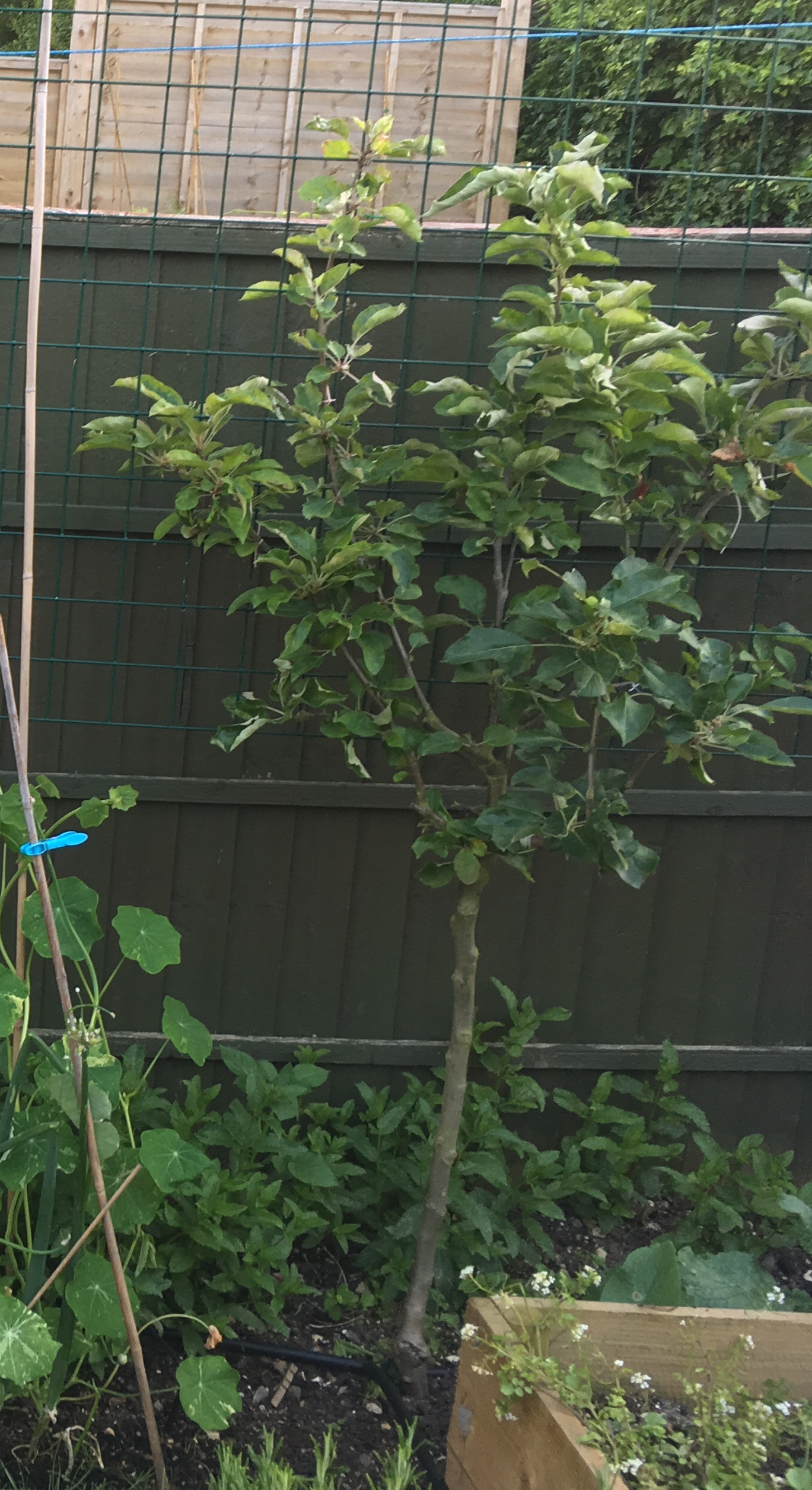
Summer of 2018 with mint and nasturtiums planted around the base.
They taste great (with a proviso)
The apples you pick off your tree will be fresh, naturally ripened and juicy. The proviso is that for your apple to also be sweet and tasty, you do need to have started with a sweet and tasty variety. If you grow a crab apple you can’t expect huge sweet fruit. Anything that is called a cooking apple will not taste great for eating straight off a tree.

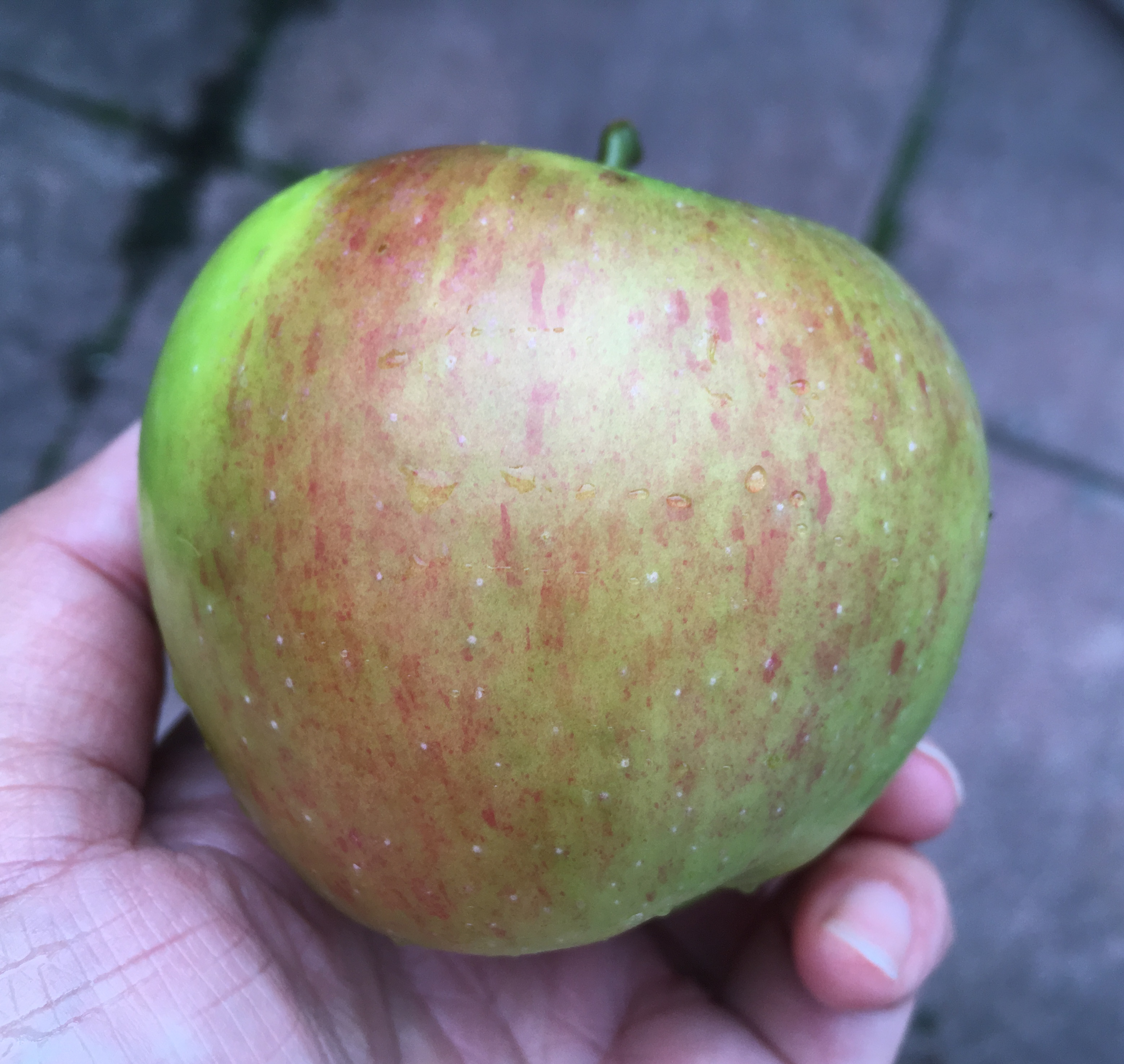
I can with total honesty say that I have never tasted an apple that was as good as the Jonagold we picked from our tree early autumn last year. So many fabulous varieties are unavailable in the shops, but even a Golden Delicious apple picked from your own tree tastes nothing like a Golden Delicious from the shops. When you are picking your own, off your own tree, in small quantities, you have the luxury of picking individual apples as they ripen. If an apple is ripe you also have the luxury of leaving it on the tree a few days until you’re ready to eat it. You don’t have to worry about having to pick thousands of apples off hundreds of trees as they ripen together. Consider labour intensive fruit picking. Is the commercial picker really going to inspect each apple for perfect ripeness or are they just going to harvest absolutely everything that looks remotely ripe? If they are harvested by machine everything is collected off the tree at once. Leaving apples too long to ripen fully comes with the danger of apples going bad. The apples have to be picked before they are ripe in order to give them time to get to shops and to have a decent shelf life. Most are then put into long term refrigeration, allowing apples to be available all year round (source). I’m appreciative of this method as it means I can buy an apple any time of year, but it’s no wonder that a shop bought apple just can’t compete with a home grown one.
They can be grafted
You are unlikely to get a tasty variety from seed. Apple flowers can be pollinated by the open flowers of any other apple tree in the local vicinity. This means that the seeds of an apple that you like will probably not produce a tree that produces apples that taste like the original. In addition, it takes several years before you get any fruit from a tree grown from seed, so a graft gets your tree fruiting sooner.

An amazing 2 variety tree that we pass on the school run.
In order to get a specific variety, a cutting is taken from the chosen variety and grafted onto a rootstock (a young apple tree with strong roots). Basically, all Golden Delicious are grown from trees that are clones of the original Golden Delicious. You can read more about why seeds don’t always produce plants that are the same variety as the parents in ‘Pollination, fertilisation and variation’
Another great thing about the grafting means that you can have more than one variety grafted onto the same rootstock. You get to have more variety without needing to use the space of two (or more) trees.
Dwarfing root stock is great for small spaces
With the small size of city gardens, it can be quite hard to fit much in. Most fruit trees suitable for the garden have a dwarfing rootstock. This rootstock determines the eventual height of the tree, which will be somewhere between 1m to 4m depending on how dwarfing the rootstock is. This means you can choose something that won’t become a nuisance in the space. The rootstock may also provide better disease resistance, hardiness or sturdiness.
There are plenty of pollination partners
Apple trees are very popular in domestic gardens. There is often a plethora of crab apple trees growing in urban areas too. This means that if you only have one tree you are still likely to have a suitable pollination partner in the vicinity. There are a few apple varieties that are self-fertile (can pollinate itself) but most need another apple tree of a different variety in order to set fruit. The ones that are self-fertile tend to have better harvests when cross pollination can occur. Apple trees that are grafted with more than one variety will usually have varieties that will pollinate each other.
Apple trees are suitable for training in forms
If you are short on space or want a living screen, you can prune the apple tree to make a productive and attractive feature.

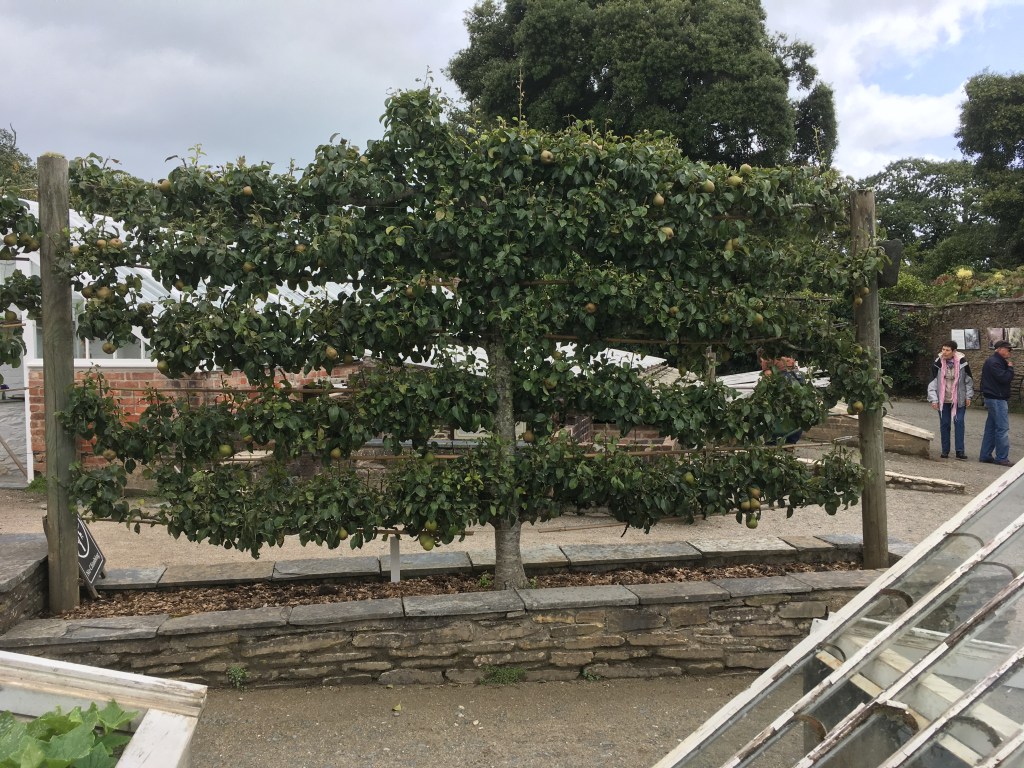
This kind of espalier training will take 4 years to get the 3 tiers and needs some maintenance. This makes a great screen or hedge. 
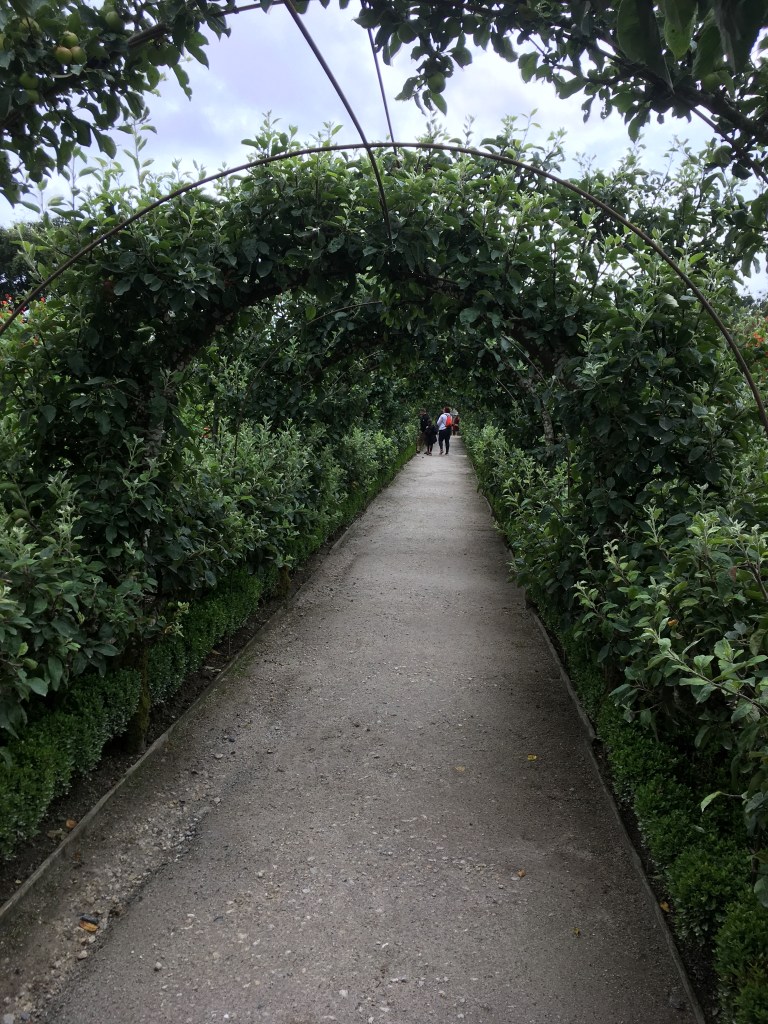
In the Lost Gardens of Heligan in Cornwall there is this amazing apple tree tunnel.
Cheap and easy
Bare root trees (usually available late autumn until very early spring) are great as they are cheap and easy to transport. If like me, you are trying to do up a garden on a budget it makes it easier on the mind to buy fruit trees bare root. I have even found a bare root with 2 varieties grafted onto it here. I can’t however give you any experience of this website as I haven’t bought any fruit trees from here.
It may take a couple of years to get productive, but apples are generally reliable as trees that do well in English weather and pay for themselves in produce over time.
Growing your own is environmentally friendly
Having a tree in your garden will capture carbon whilst providing you with more oxygen as the tree photosynthesises. In addition, your apples have zero food miles and packaging. As well as food miles, the time spent by store bought apples in storage will have a carbon footprint attached. They are kept in a low temperature, low oxygen environment to keep the apples fresh. Basically, an apple, bought just before the harvesting season begins will be an apple that has been stored for almost a year.
My apple tree
Despite extolling the virtues of growing a bare root tree, my apple tree was a potted one I bought in the summer of 2017. This is because of the timing of the creation of the garden which you can see here and also because I really wanted this crazy 5 variety tree from here.
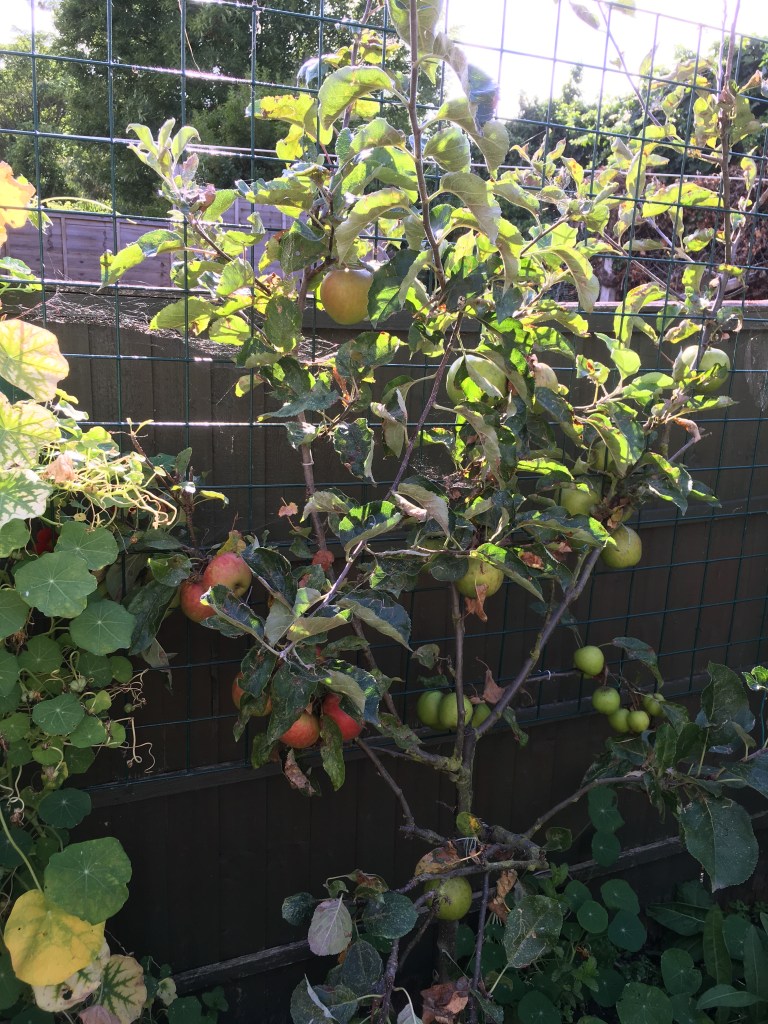
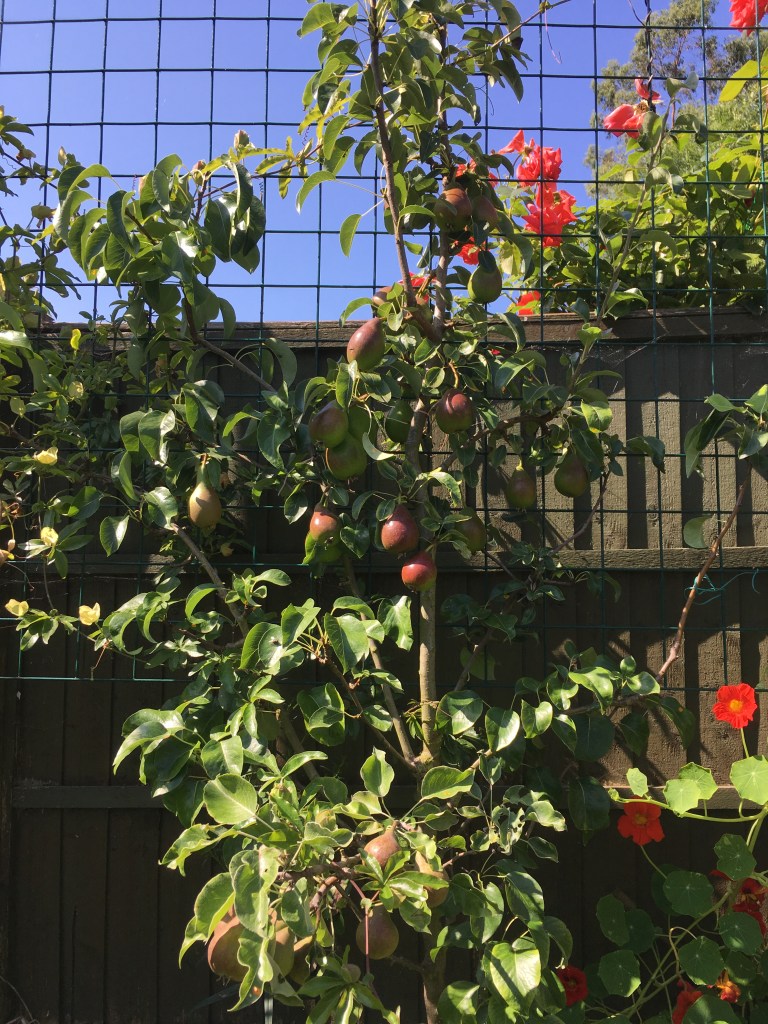
You can see the different sizes and colour of the apples
It was expensive but is unusual to have that many varieties on one tree and this website was the only place I could find it. Even in the winter this particular tree is not available as a bare root. It has a very dwarfing rootstock and so is only expected to grow to 6-8ft. I get to have a small-ish tree with a variety of flavours that pollinate each other.
Summer 2018 there were a couple of apples of 2 varieties growing, but by the end of summer they all dropped off without growing much. Autumn 2019 there were 4 varieties that we harvested. Unfortunately, we are still not entirely sure which variety is which, which is part of the fun! We do know that we absolutely love the Jonagold – that is, if we identified it correctly. These are the varieties that we have on our tree:
- Cox – striped red and yellow apple with crisp sweet flesh
- Elstar – a marbled golden yellow with some deep red and crunchy white flesh. Sweet with some balanced acidity.
- Golden delicious – golden green small apples that are sweet when ripe.
- Jonagold – huge lovely yellow apples with red flushes. They are sweet with some balanced acidity.
- Red Boskoop – lumpy dull red with russeting sharp cooking apple.
With different varieties on the one tree I will need to be careful to ensure via pruning that one variety doesn’t become too dominant. Another drawback of the many varieties grafted onto one tree is that if my tree’s trunk is damaged then I can kiss goodbye to all my varieties.










 Not a Horticulturist